|
|
|
blog
Personal thoughts and experiences on an ongoing basis. Share your comments: info @ owenericwood.com
An Explanation of Quality Time with the Family
November 17, 2009
While I was in Italy exhibiting my installation "Quality Time with the Family," I discussed my work with Francesca Franco, an art historian who had a theory about the theme of escapism in terms of my project. Since Italian is her mother tongue, I later took the time to write down the following for her since she said her written English is better than her verbal skills.
My original intent behind my video installation "Quality Time with the Family" is to create an experience for the viewers that causes in them an emotional response and psychological state that are similar to the way I have felt when I am eating dinner with my family.
The emotional response includes feelings of loneliness, isolation and alienation; and the psychological state is one of frustration, confusion and sadness in respect to a situation that should be a time when my family becomes stronger, strengthening the bonds between us through conversation, familiar gestures and physical intimacy. However, I have felt the opposite. Although we are together, the bonds between us feel artificial. Conversations seem like one-way monologues; we talk but we do not listen. My mother will ask a general question about my life but soon after I start speaking, her mind is somewhere else. It is as if she feels that asking the question is enough, that she does not feel she needs to listen to the answer. My father has always been a quiet person. He internalizes everything. He lives inside his head. The behaviour of my parents is copied by their children, so what should be quality time with the family is not quality time at all.
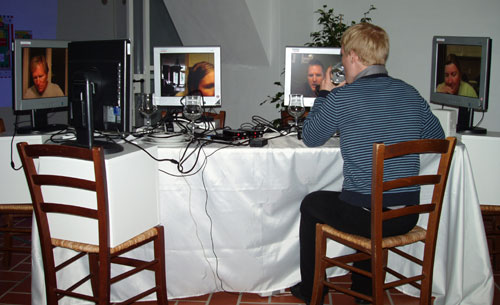
Like the title of the project, many of the elements are also ironic. The videos, the table setting, my performance and the arrangement of the electrical cords and equipment are all used in ways to create a paradox or double meanings that contradict each other. I do this to construct a tension between what something is trying to be, and what that thing actually is. This can also be said to be a comparison between what is an accurate depiction of reality, and what is an artificial construction or emotional interpretation of that reality. SImply said, all of the elements of the project recreate a life-sized model of the event of my family eating dinner but none of the elements can truly recreate the real experience; they are always doomed to fail. However, the inadequacies of the visual elements mimic the inadequacies of the human relationships that are depicted.
The videos of each of my family members are two-dimensional, short clips that represent only fractures of time. Even if the dialogue was not cut out, the videos are recorded moments so they could not ever talk to each other, and they certainly could not interact with me while I do the live performance. Furthermore, to emphasize that these videos are merely fractures of time, each video has been edited in a unique way. the editing is subtle so it does not distract from the overall impact of the project. The clips of my mother, for example, run backwards to comment on how the actions we do when we eat are a type of loop. Chewing, drinking, even laughing are the same backwards and forwards. The clips of my younger brother are cut short and rapidly repeated to point out the monotony of the action, while the clips of my older brother are sped up when he was eating slowly and slowed down when he was eating quickly to make his movements more consistent, more mechanical like an automated machine. the videos of my father and sister were edited in relationship with sound*. For my father, I simply cut out all the sound except when he speaks the short phrase "a long time." I wanted to make a satirical comment about how my father barely speaks by giving him the only voice at the table. Although the phrase was his response to an unrelated question, "a long time" directly relates to the element of time in many aspects of the project. My sister's video is edited so that the background noise is only heard when she is chewing her food, which is a playful way to point out how all members of my family have been silenced by the technology (and by me), and that both the background noise recorded in the kitchen as well as the physical equipment involved in the installation are overwhelming them. Although they clearly represent the figures in my family - mother, father, two brothers, sister - their personalities have been taken away to cause one of the paradoxes in the experience; I offer the viewers the opportunity to observe my family, but the experience I offer is highly manipulated so the viewers cannot learn anything about my family members as individuals. But again, this reflects the overall irony of the project.
(*Note that for Visionaria, all the audio was placed on one track coming from two speakers so the relationships between image and sound are not exactly as they are described here.)
The table setting and my live presence are also an obvious artificial construction. Plates and glasses are laid out for people that the viewers know are never going to come, and I sit and eat with people who I know are not there. But it is not important that the experience achieves reality. What is important is that I create a futile action that continues despite the fact that I know it is futile. More importantly, that I create an experience that viewers believe despite the fact that they know it is not real. I feel that the majority of the responsibility for achieving this lies in my performance. It is important that I remain committed and focused on my immediate environment and ignore the viewers who are watching me, in fact act as if they do not exist, which I realize can create negative feelings of alienation among them but this if part of the point - they they feel detached from me despite the fact that I am right in front of them, sharing the same space. The goal is that I become a living sculpture, not a living person but merely an animated object among the other physical materials in the installation. Or, the viewers could start to read my presence as though they are watching a recorded video of me instead of me being actually there. In any case, the theme of disconnection is meant to be expressed through my lack of interaction with the viewers.
This theme of disconnection is physically represented with the placement of the electrical cords on the table. The entire installation is obviously an artificial construction, a futile illusion that nobody will believe is a true representation of the people in my family, so I feel no need to hide the equipment that is used to create the illusion. In fact, I use the cables as a metaphor to represent the irony of communications technology. Although televisions, cell phones, text messaging and the Internet are meant as aides to help us connect with each other, they do not replace (in fact, cannot replace) the connections that occur during physical human interaction. The irony here is that although all of the electrical cables are connecting the equipment and therefore allow all of the video and audio elements to come together, the wires are placed in a tangled mess all over the table, taking over the human activity that should occur in that space. Although I am grateful for the technology that enables me to do my art work, especially in the case of video, I am apprehensive about it taking over my life by disconnecting me from the physical world, by substituting real experiences and interactions with virtual ones that are mediated by some form of mechanical device. Most importantly, I worry that I am losing time (and essentially my life) because much of what I do and what I see is experienced through a monitor. I feel a loss of humanity - that in Canadian and American life especially, television and more recently the Internet are interfering with our ability to relate to each other as human beings because people are not using communications technology as merely facilitators to communication but as the main means of communication, and in a real sense have replaced human interaction with an interaction that is mediated by technology. As a result, I feel the society in which I live is losing touch with values associated with family, friends, neighbourhoods or communities and other forms of human relationships.
I cannot speak for other places, but taking note of the fact that Italy has a culturally-instituted practice of stopping activity in the middle of the day and then again at night so that people can sit down together to enjoy long, relaxed meals tells me that thins are better in Italy (at least in this respect). In fact, I am very happy to present this project in Italy because I think it reasserts faith in traditional social values that countries like Italy preserve.
I think it is also important to point out that although "Quality Time with the Family" is essentially about a social problem, the act of creating the project and, in turn, exhibiting the project not only suggest a solution to the problem but also activate that solution. From the beginning, my family had to participate in the project, which engaged them in what I am doing in my life - my art. Although their engagement was limited, their willingness to be videotaped in itself is a symbol of our familial connections. Their knowledge of my acceptance into the Visionaria festival further engages them in discussion about the project and my art work in general (when they ask specific questions, and then follow-up questions, I know they are listening). In the case of my older brother, he was actively engaged in the creative process, asking questions (sometimes even telling me how I should do the project). He was the person who suggested the idea of videotaping the dogs, which I did and I added the extra monitor on the floor as a tribute to his participation and contribution to the project.
In terms of my own social development, creating this project has given me the ability to look at my family and more importantly myself as an outside observer. I could watch how my family members interact with each other and how I interact with them. I discovered that what I thought to be the reality of the situation was for the most part not the reality but only my perception of reality. There was more happening that my biological eyes didn't see, but that the video camera caught on tape. Technology can allow us to literally look back at a moment and see it from a different perspective, which is why I feel it is important in this project to make contradictory statements. By doing this, I acknowledge that there are ways of seeing things that are different from how I see them. In the project in particular, I purposely isolate myself from the audience to create a sense that much of the emotional content of the project (as well as the psychological content) is internalized, and perhaps I am the cause (or at least a major contributing factor) in the disconnection I feel with my family. Perhaps I need to change my behaviour and/or my perception in order to change reality.
Lastly, the act of exhibiting this installation and participating in the Visionaria festival is a key example of breaking out of the isolating and lonely process of making art to bring it into a social situation where the experience is no longer just my own but shared among a larger community. In itself, this breaks down much of the problematic social behaviour that this project critiques. So it is not just the art project itself that deals with the concepts, but the processes of creation and exhibition that extend the ideas and manifest them into changes I have made in my life, which is key in maintaining the genuine and personal nature of this project.
Visionaria Video Festival, Piombino, Italy
November 6, 2009
|
Here is a picture of my the video installation Quality Time with the Family, which I performed as part of the Visionaria Video Festival in Piombino, Italy (October 24-31).
The project went over very well with the general public because it comments on the importance of using meals as opportunities to gather with those
we love and reconnect, which is a practice that remains at the heart of Italian culture.
New Project Added: Holobomo
July 21, 2009
|
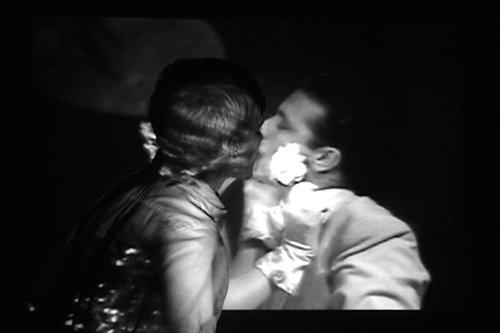
I have added information about my video Holobomo to this site.
In Holobomo, I use video projection on sculpture to express a desperation as I attempt to insert myself into scenes taken
from black-and-white movies. This is an exercise of "re-appropriation" as I have taken all the imagery (and some of the sounds)
from Imitations of Life by video artist Mike Hoolboom.
(MORE...)
The Clothes Make the Man at FIMA
July 5, 2009
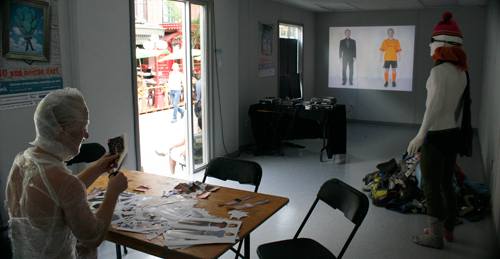
photo: Vincent Chine |
On July 2 and 3, I presented the installation version of The Clothes Make the Man at the Festival International Montreal en Arts (FIMA).
I adapted this project to allow for audience participation for the first time. Viewers were allowed to join
me in the activity of dressing up paper dolls, and taking them away as souvenirs if they wanted. I also incorporated
a life-size sculpture of myself dressed in a random clothing items from the pile of clothes beside it.
(MORE...)
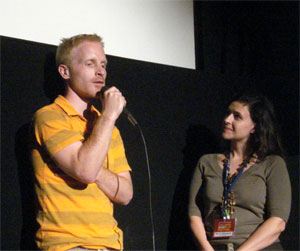
Owen Eric Wood and Myrocia Watamaniuk at the Worldwide Short Film Festival
Toronto, Canada, June 2009
Photo: Shannon Ridler |
CFC Worldwide Short Film Festival
June 25, 2009
I am back home from traveling to Toronto where my video Made Up screened as part of the
Canadian Film Centre Worldwide Short Film Festival, which ran from June 16-21, 2009. It was the first time I had the opportunity to
attend a festival full time and it was a great experience. All the screenings, workshops and social events aside,
I appreciated the opportunity to answer the questions posed by WSFF Senior Programmer Myrocia Watamaniuk
after each of the two screenings of my video.
I spoke about the use of self portraiture in my work and how I combine reality and fiction in the piece.
The second audience was a particular surprise since people laughed more than any previous audience that has seen Made Up.
I think they were a sophisticated bunch who understood the satire in the piece. This festival is a fantastic experience for filmmakers.
(MORE...)
New Project Added: Parallel
June 13, 2009
|
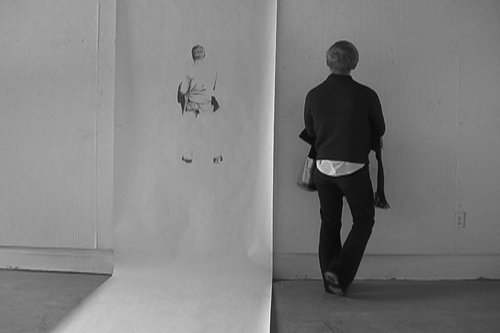
I have added my interdisciplinary art project Parallel to this site.
Parallel merges photography, drawing and video in a poetic offering on what it means to create.
On the Web site you will find detailed information about how the field of theoretical physics influenced the script.
(MORE...)
File Sharing and Copyright:
The Curious Case of Phil Collins
by Owen Eric Wood
February 26, 2009
I just got back from a screening at the Rendez-Vous du Cinema Quebecois festival in Montreal where I saw "RIP: A Remix Manifesto," Brett Gaylor's documentary on copyright and intellectual property. The documentary focuses on Girl Talk, who creates songs by remixing clips from other musicians' work, in its entry point into the complex legal and philosophical issues surrounding the impediment of copyright laws to cultural evolution. Gaylor covers a lot of ground, from Metallic's anti-Napster attitude to Readiohead's experiment to offer its latest album online, letting the consumer decide the price. Gaylor offers a comprehensive account of key historical events and important figures, not all of whom I was aware of walking into the theatre. His arguments aside, I thought I'd bring my own experience into the mix, or should I say "remix?"
It was the summer of 2002. I was attending a barbeque when I ran into Jeff Leech, a guy I went to high school with. As it turns out, he had gone on to become a high school art teacher. He told me an anecdote that has since popped back into my mind whenever the discussion of music downloading and online file-sharing networks comes up.
He was in the middle of giving a lesson when he made some off-hand remark about Phil Collins not being cool. A couple of his students got up to defend the former member of Genesis. "What do you mean Phil Collins isn't cool!?!" they demanded. Jeff was startled by their reaction. Why were these kids defending Phil Collins? Better yet, why were they even listening to his music in the first place? These teenagers weren't even born when Collins released No Jacket Required, which hit #1 on the charts and went on to win the Grammy award for album of the year.
As it turned out, they had downloaded his music. The interesting point here is that through the process of trading digital music, the students had obtained songs that were each labelled with a file name that, at best, indicated the name of the song, artist and album. This is the only information they had. They had never purchased a Phil Collins album, they had never seen his videos or attended a concert, so they were free of all the imagery and external imformation attached to the music. The students were ignorant about who Phil Collins was, where he was from and, most importantly, what time period his music came from. They had no idea that Phil Collins wasn't cool.
This is where this story goes from being interesting to inspiring. Because the only exposure these kids had to Phil Collins was his music, the were in a position to judge their taste based on the music itself. They were not mere passive consumers of the music promoted to them through magazines and TV. They were free to decide that Phil Collins was cool.
I wonder if there is a deeper issue at hand in the depate over so-called "intellectual property." Perhaps it is not limited to ensuring compensation for the owners of an idea (in this case music), but also controlling the distribution of ideas so as to limit the access of individuals. It is much easier to ensure consumers buy a certain product when their access to alternatives is limited or outright denied. File sharing undermines the persuasive powers of mass media to convince us to buy into specific products at specific times, to make us believe that new music is in fashion, while old music isn't worth listening to.
Downloading music from peer-to-peer networks, on the other hand, empowers people to discover music from different cultures, genres and time periods. It allows people to listen to what they want when they want, and to discover musics years, even decades, after it is originally released. And, when they are not satisfied with what they find, as in the case of Girl Talk, computer software enables people to remix old tunes to create the sound they want to hear.
As a video artist who is struggling to maintain my art practice, it disturbs me to think someone could take my work, use my material and change its context without my permission and without paying me for my work.
Artists should be paid for what they do, and if there is a company backing their work, this company deserves to benefit from its investment. However, I can't help but wonder, what would Phil Collins think if he knew that a new generation of fans were discovering his music because of this new form of distribution, that his music was holding its own among contemporary teenagers along side the likes of Pink, No Doubt and Eminem?
It is a tough balancing act to satisfy the harsh realities of financial compensation with the ideological right to a free exchange of information. While one ensures the physical needs of artists and companies to exist and continue to produce work, the other ensures that the work will live on, past those who created it.
Interview with CKLN Radio
February 19, 2009
CKUT's John Custodio interviews Owen Eric Wood for the radio program QueerCorps, February 16, 2009.
In part one of the interview, they discuss Wood's video Made Up and the concept of masculinity in relation to queer identity.
In part two of the interview, former QueerCorps technical director Paul N. joins the
conversation to discuss gay chat sites and Wood's video 'Lost.'
Interview: Part 1
Interview: Part 2
Artistic Recognition and the Self Portrait
by Owen Eric Wood
January 30, 2009
Someone recently pointed out to me a fundamental aspect of my character. I have something inside that I haven't been able to express, and I feel my creative abilities are not recognized.
I realize that many artists crave recognition, but in my case this pursuit of the ego is literal. Much of my work involves self portraits. Photography, sculpture, video — I even insert my physical self inside projects that call for a performative element. I want to be recognized not just for the work I do, but within the work itself. I need to be seen.
A teacher once told me that my use of self portraits will contribute to my success by making myself recognizable. I have always seen it as insurance — insurance that I maintain a personal connection to my subject matter. One of my main concerns as an artist is to negotiate a balance between personal and universal content, content that comes from the heart and is sourced in my real-life experience, but also content that touches upon themes much larger than me so that a broad audience can connect to it.
My use of self portrait allows me to directly reference myself and my life while providing a means to represent the external world. I can become the figure at the center of the issues I discuss. In my video Made Up (2008), I take on the roll of a person being interviewed about what he finds attractive. In the video, it is not clear whether it is a real interview or if I am performing since the viewer sees and hears me, not an actor. I sit in front of the camera. I voice is heard in the candid conversation. If it wasn't me, it wouldn't be as believable and what happens in the video would perhaps not be possible.
Still, I ask myself how far I can push the use of the self portrait as an artistic technique. I am currently using it in three ongoing projects, and legitimately so I would argue, but I wonder there will be an end to it. What if I get over my spiritual dilemma and satisfy my desire for recognition? Or if I learn not to need recognition?
I am experiencing a case of humility in light of being shown that I am flawed. I feel slightly ashamed even, not because of the flaw itself but because I needed to be reminded that I am only human. I am filled with unexpected relief, too, as though my great expectations have been brought down to more appropriately reflect my small life. And this is alright. I think it is easy to forget why one makes art when fighting for acceptance in the professional art world. Artists must spend more time promoting their work than making it.
I don't know to what extent I have lost myself. I know I have lost friends, got into a lot of arguments, missed out on social events and almost lost the best relationship I've had in my efforts to advance my art career. These were not choices but mistakes I made along the way, and not all were my fault. I am not free of error. Like many people, I am susceptible to the delicate creature that is the human ego. But I consider the fact that I acknowledge my flaws and that I can admit to them to be a strong foothold towards self discovery. I can see that my expectations have been trumped by a great revelation — that my ambition for external recognition is worthless if I can't recognize myself.
Attention "Obsession" Disorder
by Owen Eric Wood
November 22, 2008
I suffer from information overload. When I am exposed to too many ideas or too much information, my brain automatically begins to filter to reduce the amount of stimuli that gets in. When it's too much, I don't feel like talking to anyone and I find the idea of leaving my apartment intimidating.
It's not that my mind can't handle new information. Far from it. When I come across something that is interesting, my thoughts explode in a hundred directions, branching off exponentially, discovering links between seemingly unrelated subjects. I cannot simply go "hmm..." and move on.
One of my brothers has ADD (attention deficit disorder). In the beginning of his diagnosis, it was challenging to hold a conversation with him. His thought process races forward at speeds the physical limitations of speech simply cannot keep up with. Listening to him was like listening to someone read a book except that he only read the first sentence of every page. Where "normal" conversation follows a logical train of thought with one statement leading to the next, my brother would say one thing and then jump 10 ideas ahead and assume his listener had the information to fill in the series of ideas that lead there. The logical train of thought existed, but most of the thoughts remained in his head.
I wonder if I have the opposite of my brother's condition. Instead of racing forward, my concentration is locked at the starting point as I analyze every aspect of the idea, finding connections, discovering meaning. It is as though I am not satisfied with a mere passing glance; I seek perfection in understanding. And until I reach that point, my mind shuts out everything else.
I wonder if this quality is a factor in my interest in interdisciplinary art. Is my need to communicate in various art forms actually a desire to better understand the art works of others? To better read the information other artists are transmitting? Is my obsession to be a multi-linguist in visual languages?
My brother is better now, better at communicating with others I mean. I don't know how he did it exactly. I remember having conversations with him in which I forced him to slow down , to take pause and explain his points before rushing forward. He doesn't have this problem now. In his way, he's learned to talk down at the level of us regular folks.
I don't think I can solve the problem I have, or that it even is a problem. I had difficulties when I was a journalist, too. I felt I was expected to know everything about everything all of the time. As an artist, I strive to pull everything together to prove it is all related. In one of the projects I'm currently working on, I am merging photography, drawing and video to discuss issues of philosophy, physics and art. From my perspective, I am only dealing with one subject that happens to be occurring in multiple forms, both formally and conceptually. In my way, I simplify the world to bring it down to my level of understanding.
But in doing so, I discover things are not as separated as they seem to be.
Thoughts on the Future
by Owen Eric Wood
October 8, 2008
Last December I set a goal for myself: to have my art work shown in an exhibition or festival once per month for the next year. Twelve months. Twelve exhibitions. It is only October and I have reached 13.
It is a difficult task, wrestling with my ego; I usually deny I even have one. I like to think that I constantly question what I do, that I push myself to face new challenges, that I fight the urge to settle with past achievements and baste in my own success. However, these past months I find myself watching my list of festivals with an obsessed dedication, allowing the rush of enthusiasm and self praise slip up my spine with each acceptance letter.
Browsing Web sites of established video artists to research the development of their careers in search of helpful hints for my own future, I find they have lists, too. Lists much longer than mine. I'm not intimidated. I haven't been at this as long as they have and it isn't about being competitive. Art is not a sport. There is no winner. But how do you measure success?
I stare at their lists and I stare at my own and suddenly I am overwhelmed by anxiety, the kind of anxiety I feel when I read obituaries. Is that it? The sum of a person's life? A selection of official recognitions, career highlights and personal bests? And I ask myself, is this what I am aiming for?
A couple of years ago, I contributed to a dialogue for the British art publication Tangent in which artists were asked to share their personal definition of success. I wrote that there are different kinds of success from making art to selling it, but what I appreciated most was when someone connects with what I create. In the case of my video-projection-on-sculpture piece titled Eric and Eric, which depicts the struggle of two lovers, one woman told me she was touched by the image because it helped her understand an emotional aspect of gay relationships, which was important for her because her finance had recently left her to be with a man.
It is impossible to determine an artist's worth based on such events because these moments are not documented. It is a rare and lucky experience for artists to bear witness to such a connection between a viewer and their work. For the most part, these connections occur without mention. It is a private affair between the viewer and the work, and the artist is left out of it.
But what if I could keep track of people's reactions to my art? What if I could somehow record these responses and use this material not only as a replacement for the "list," but also as a kind of collection of observations to study and reflect upon when I create new work? What if I made that my new goal for the future?
Links
Eric and Eric, video projection on sculpture
Tangent Contemporary Art Fanzine
Exhibition in Frankfurt, Germany
September 16, 2008
|
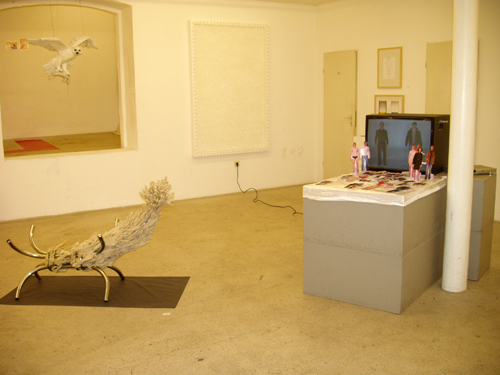
In January 2008, I was among a group of Montreal-based artists who traveled to Frankfurt, Germany for a
collaborative exhibition with local German artists. I performed my piece The Clothes Make the Man.
Seen above is the Gutleut 15 Gallery, including the material that I left behind as the exhibition continued into February.
I have mixed feelings towards the success of the experience. On the one hand, it was my first international
exhibition; that alone is enough validation. But I learned a lot. One mistake I made was to performed a piece that
prevented the audience from interacting with me (The Clothes Make the Man is about having to rely on
two-dimensional imagery of a person despite the fact that the real person is right infront of you).
I think I lost an opportunity to interact with an international audience. I will keep that in mind in the future.
(MORE...)
Integrity and the Art of Self Promotion
by Owen Eric Wood
August 27, 2008
When I was a journalist, I always felt insecure because I didn't know much about anything. Journalism is the ultimate catch-all profession, which comes with the constant pressure to know everything about everything all of the time. The accumulation of information was the attraction for me. I was always learning — learning about writing, learning about the subjects I was writing about, learning about computer programming and Web design. However, after three years, I still felt like a neophyte among giants. Every time I got close to knowing anything I was shipped off to another story.
At the end of October, I will accompany one of my art works to Spain for five days of workshops, exhibitions, lectures and idea sharing between international experts in media art. I will serve my country as an ambassador of sorts. Once again I will be among giants, and I worry if I have anything to say.
I am an expert on nothing but myself, my experience and my work. I can talk about what I do and how I use media to achieve artistic goals. I can speak of what my work is about and of my philosophical approach to art as a form of communication. But I am apprehensive about putting what I do in context with the contemporary art world.
I am no historian, I am no critic, yet, as an artist today, I am expected to take on these roles. Making art is no longer enough. I must write about it, talk about it, distribute it, sell it. I must be an interdisciplinary art marketing machine. I wonder at what point it all becomes shameless self promotion.
This is not unlike the ongoing internal struggle with self doubt that all artists endure in the creation of their work. Is what I am doing important? Worthwhile? Good? In my case, since the majority of my work involves self portraits, I must also defend my work against accusation of self-indulgence.
More than 150 years ago, the German interdisciplinary artist Richard Wagner (1813-1883) wrote of the justifications behind making art in his essay "The Art-Work of the Future." He wrote of the importance of a "genuine want" and a "true need" and described those who feel no want as "artificial, untrue and egoistic," as having "the empty need of preserving superfluity." Wagner wasn't just referring to artists. His words apply to a much larger scope of professions. However, applied to artists, he was pointing to those who make art not because they have anything to say, but because they want to have the status of being an "artists." Wagner was referring to integrity.
There is a conflict of interest that arises when I take on the role of journalist of myself. Not only is objectivity at risk in terms of what I say, but there is also the question of whether I should be saying anything at all. Would Wagner define my motivations as having a true need? Do I contribute to a collective want? Or do my actions simply serve to feed my insatiable ego? I remind myself that the organizers of the festival in Spain looked through the submissions they received and chose to accept my work — that by having an outside body delegate my work's worth is enough to justify a need for me to talk about it.
But maybe I am misinterpreting Wagner's words and blowing the issue out of proportion. Perhaps no one expects me to justify what I do. Perhaps the point of art festivals is actually the reverse. Instead of aiming to explain what I do, maybe the purpose of exhibiting is to give others the opportunity to express what they think about what I do, to give me objectivity, to help me understand myself better. In return, I give my perspective on what they do to help them. And this is the point of cultural exchange.
Links
Momentum to premiere at Canariasmediafest in Spain
"The Art-Work of the Future" by Richard Wagner (1849)
Ignorance and Appropriation
by Owen Eric Wood
August 9, 2008
I'm working on a video called Holobomo. The project uses appropriated footage taken from old movies. Actually, I consider the footage "re"appropriated since all of it comes from Imitations of Life by Toronto-based video artist Mike Hoolboom, who constructs new narratives using borrowed footage. If there is an expert on appropriation, it's him.
I e-mailed Hoolboom to request a copy of his video to grab clips from for my video. It turns out he already had the video online for people to download for that very purpose. In my e-mail thanking him, I commented in the end how I used to think people who appropriated material were just too lazy to make their own images. I was joking, but I regret writing this since sarcasm fails to translate over the Internet.
Editing this new video, I find creating new narratives through the restructuring of appropriated footage takes just as long as if I were to shoot new material myself. Some of the images seem to fall perfectly in place, in sync with the text and sound as though they were meant to be together. But then I find myself placing clips in literal relationship with the text, which becomes obvious and uninteresting.
This is always the challenge with incorporating text in visual art projects. The text cannot simply be an explanation of what you're looking at, nor can the images be only an illustration of the text. They must work together to achieve the same goal, while maintaining a degree of independence where they communicate the message in their unique ways.
The magic of Hoolboom's work is that he creates intriguing relationships between his narratives and the footage he borrows. An image will add a new layer to the meaning of the text, or vice versa, adding irony, humour or some unexpected element that provokes thought.
Perhaps my ignorant comment to Hoolboom was due to a disappointment I had during my time in school, when I felt the students who used appropriated footage were making a mistake by not taking advantage of the top-notch camera equipment we had access to. I find it difficult not to apply to others the standards and expectations I have for myself, but I know it is arrogant and condescending of me to do so.
Links
Download "Imitations of Life" by Mike Hoolboom (2003)
|
|

